Amazon Ads has become more competitive than ever.
Yet after nearly 10 years of managing Amazon Ads accounts across different categories, I've noticed something surprising:
Most advertisers don't fail because Amazon Ads are complicated.
They fail because they make the same handful of mistakes over and over again.
Some of these mistakes waste advertising spend immediately. Others are more dangerous because they quietly limit growth for months before anyone notices.
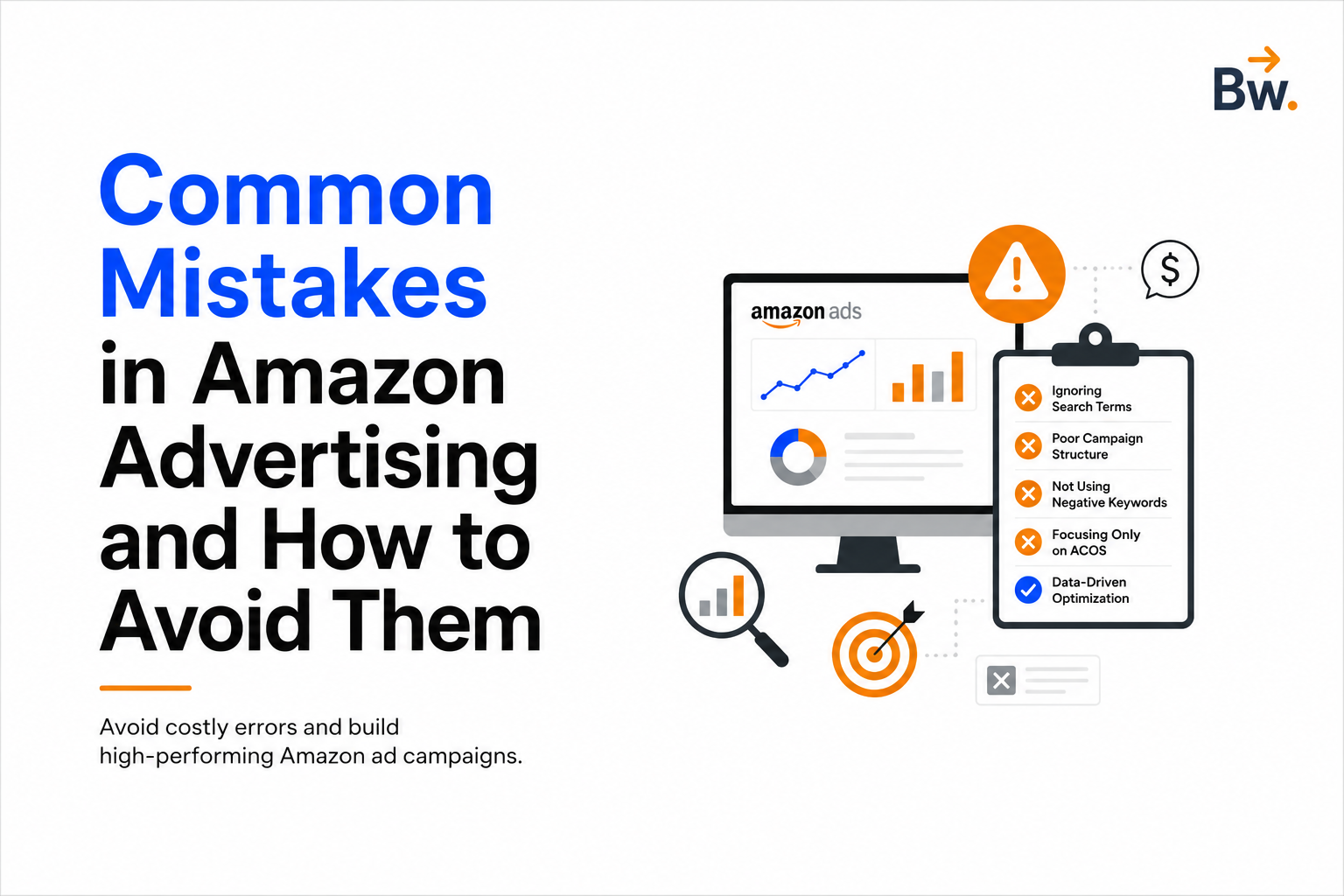
If you're investing in Amazon Ads, here are some of the most common mistakes I see—and how to avoid them.
1. Focusing Only on ACOS
This is probably the biggest mistake in Amazon Ads.
Many sellers treat ACOS as the ultimate measure of success. Every decision revolves around lowering ACOS.
The result? They reduce bids, cut budgets, pause keywords, and slowly choke off growth.
A low ACOS doesn't automatically mean your advertising is successful.
Imagine two scenarios:
- Campaign A has a 15% ACOS but generates only a few sales.
- Campaign B has a 28% ACOS but drives significantly more revenue, improves organic ranking, and acquires new customers.
Which campaign is actually helping the business grow?
The answer isn't always obvious from ACOS alone.
Instead of asking "How do I lower ACOS?" ask "How do I maximize profitable growth?"
2. Poor Campaign Structure
Many accounts become difficult to manage because campaigns are built without a clear structure.
I often see:
- Hundreds of keywords mixed together
- Multiple match types in one campaign
- Brand and non-brand terms combined
- Research and scaling campaigns merged together
When everything is mixed together, performance becomes harder to analyze and optimize.
A well-structured account allows you to quickly identify:
- What's working
- What's wasting spend
- Where to increase bids
- Where to reduce investment
Good structure doesn't guarantee success, but poor structure almost always creates problems.
3. Ignoring Search Term Reports
Keywords are what you target. Search terms are what shoppers actually type.
There's a big difference.
One of the most valuable reports in Amazon Ads is the Search Term Report because it reveals:
- Winning search terms
- Irrelevant traffic
- New keyword opportunities
- Potential negative keywords
Advertisers who regularly review search term data typically make better optimization decisions than those who rely solely on campaign-level metrics.
The real insights are often hidden one layer deeper.
4. Not Using Negative Keywords Effectively
Many advertisers focus heavily on finding new keywords while neglecting negative keywords.
This is like trying to fill a bucket without fixing the holes.
Negative keywords help eliminate:
- Irrelevant searches
- Low-converting traffic
- Wasted ad spend
- Keyword cannibalization
Over time, a strong negative keyword strategy can significantly improve efficiency without increasing budgets.
In many accounts, some of the biggest performance improvements come not from adding keywords—but from excluding the wrong ones.
5. Making Changes Too Quickly
This is particularly common among newer advertisers.
A keyword spends money for two days. No sales. It's paused immediately.
The problem is that Amazon's attribution window and customer behavior don't always work that quickly.
Advertising decisions should be driven by meaningful data, not emotions.
Constantly changing bids, budgets, and targeting before sufficient data accumulates often creates more volatility than improvement.
Patience is an underrated optimization skill.
6. Ignoring Product Listing Quality
Advertising can generate traffic. It cannot fix a weak product page.
I've seen sellers continuously increase ad spend while their real problem was:
- Weak images
- Poor copy
- Uncompetitive pricing
- Insufficient reviews
- Weak value proposition
If conversion rates remain low, the first question shouldn't always be "What's wrong with my campaigns?" Sometimes the better question is "What's wrong with my listing?"
The best advertising campaigns still depend on strong fundamentals.
7. Failing to Connect PPC with Organic Growth
Many sellers view advertising and organic rankings as completely separate.
In reality, they're closely connected.
Advertising generates sales velocity. Sales velocity can improve keyword relevance and organic rankings. Improved rankings can generate more organic sales.
This creates a positive cycle.
When evaluating campaign performance, don't just look at attributed sales. Look at what is happening to your organic visibility as well.
Some campaigns create value that doesn't immediately appear inside the advertising dashboard.
8. Treating Amazon Ads as a Set-and-Forget Activity
Amazon is constantly changing. Competition changes. Bid landscapes change. Consumer behavior changes.
What worked six months ago may not work today.
Successful advertisers regularly review:
- Search term performance
- Budget allocation
- Bid strategy
- Conversion rates
- Market changes
The accounts that perform best are rarely the ones with the most complex strategies.
They're usually the ones receiving consistent attention and thoughtful optimization.
Final Thoughts
Amazon Ads is not simply about launching campaigns and watching ACOS.
It's about building a system that consistently drives profitable growth.
Most advertising mistakes aren't caused by a lack of tools or technology. They're caused by focusing on the wrong metrics, making decisions too quickly, or overlooking the fundamentals that drive long-term success.
If you avoid the mistakes covered above, you'll already be ahead of many advertisers competing in your category.
Because in Amazon Ads, success often comes from doing the basics exceptionally well rather than chasing the latest tactic or shortcut.