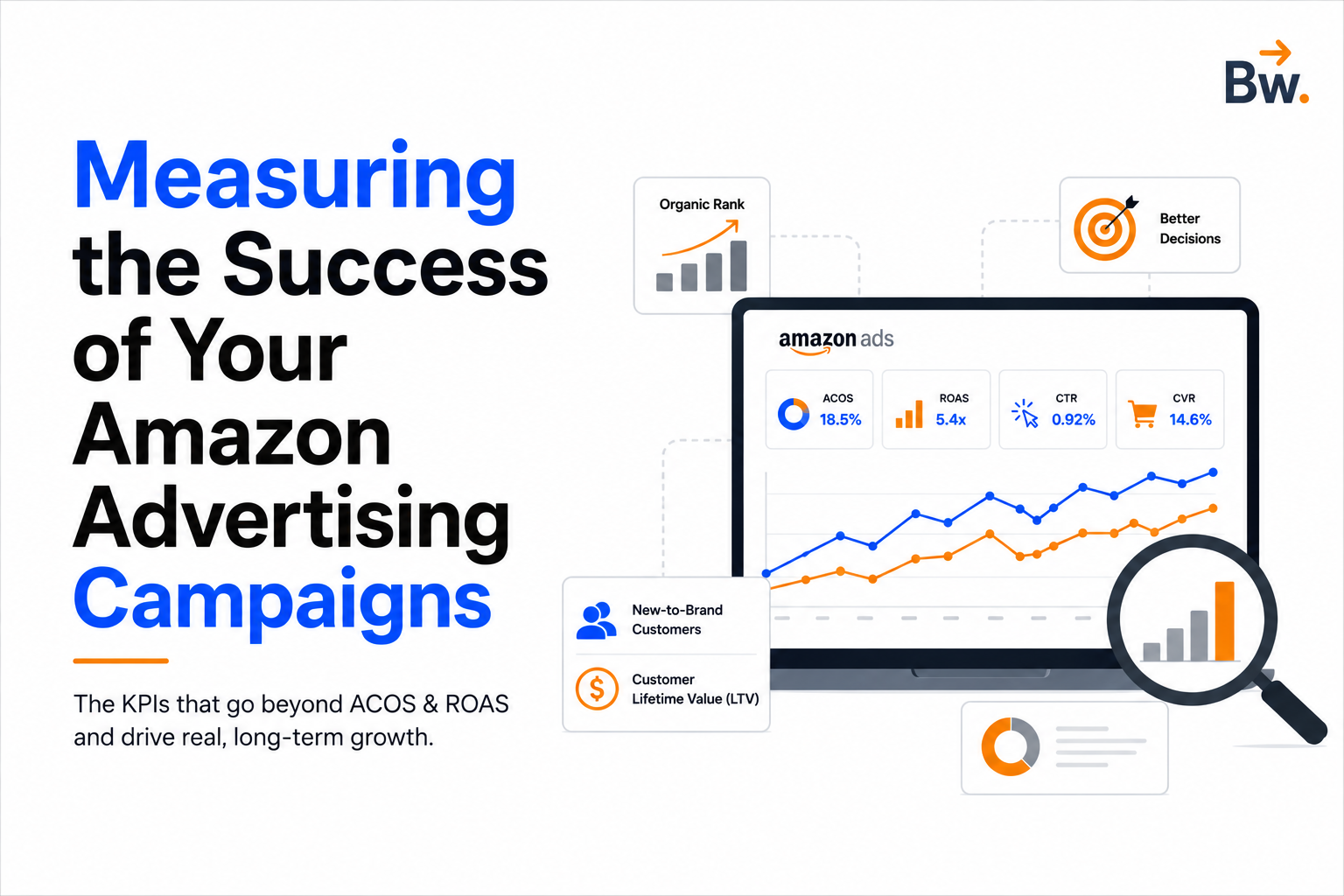
If you've been advertising on Amazon for any length of time, you've probably heard people obsess over metrics like ACOS, ROAS, CPC, and CTR.
And while these metrics absolutely matter, I've noticed something interesting after spending nearly a decade working in Amazon Ads:
Many Sellers focus so heavily on advertising metrics that they forget to measure whether their advertising is actually helping the business grow.
Amazon Ads isn't just about generating clicks. It's about generating profitable growth.
To understand whether your campaigns are truly successful, you need to look beyond the obvious numbers.
The Core Amazon Ads KPIs
Let's start with the metrics every advertiser should monitor.
1. ACOS (Advertising Cost of Sales)
ACOS tells you how much you're spending on advertising to generate a dollar (or rupee) of sales.
Formula: ACOS = Ad Spend ÷ Ad Sales × 100
For example, if you spend $20 and generate $100 in sales, your ACOS is 20%.
Most advertisers use ACOS as the primary benchmark for campaign performance because it directly measures advertising efficiency.
However, a lower ACOS isn't always better.
Many sellers unintentionally limit growth by aggressively reducing bids and budgets simply to improve ACOS.
The real question isn't "How low can my ACOS go?" It's "Am I maximizing profitable growth?"
2. ROAS (Return on Ad Spend)
ROAS is essentially the inverse of ACOS.
Formula: ROAS = Ad Sales ÷ Ad Spend
A ROAS of 5 means you're generating $5 in sales for every $1 spent on advertising.
ROAS provides another way of evaluating advertising efficiency and is often preferred by brands that manage multiple advertising channels.
3. Click-Through Rate (CTR)
CTR measures how often shoppers click your ad after seeing it.
A strong CTR generally indicates:
- Relevant keywords
- Competitive pricing
- Strong main image
- Effective ad placement
If impressions are high but CTR is low, your problem may not be your targeting—it may be your product presentation.
4. Conversion Rate (CVR)
Getting clicks is only half the battle.
Conversion Rate tells you how effectively your product listing converts traffic into customers.
A poor conversion rate often points to issues such as:
- Weak product images
- Poor listing content
- Pricing challenges
- Lack of reviews
- Stronger competitors
Many sellers try to fix a conversion problem with more advertising spend, when the real issue lies on the product detail page.
5. Cost Per Click (CPC)
Monitoring CPC helps advertisers understand competition levels within a category.
Rising CPCs can indicate:
- Increased competition
- Seasonal demand
- Aggressive bidding by competitors
Tracking CPC trends over time helps identify whether profitability issues stem from bidding pressure or conversion challenges.
The Metrics Most Advertisers Ignore
Here's where things get interesting.
Some of the most important Amazon growth metrics aren't found in the standard advertising performance dashboard.
These metrics often determine whether advertising is building a stronger business or simply generating short-term sales.
1. Organic Rank
One of the biggest mistakes I see is evaluating campaigns only on attributed sales.
Advertising does more than generate direct sales. It can improve keyword rankings.
As your products generate sales velocity through advertising, Amazon's algorithm may reward that performance with stronger organic visibility.
This means a campaign with a seemingly average ACOS could still be extremely valuable if it's helping your product climb organically for high-volume keywords.
When evaluating campaign success, ask:
- Are my target keywords improving in rank?
- Am I gaining more organic sales over time?
- Is paid traffic creating long-term visibility?
Organic rank is often one of the clearest indicators that advertising is creating lasting value.
2. New-to-Brand (NTB) Customers
For Brands, especially, those selling in consumables category, New-to-Brand metrics provide powerful insights.
NTB shows how many customers are purchasing your brand for the first time.
Why does this matter? Because acquiring a new customer is often far more valuable than generating another purchase from an existing customer.
A campaign may have a higher ACOS than you'd like, but if it's consistently bringing new customers into your ecosystem, it may be contributing significantly to long-term growth.
3. Customer Acquisition Cost (CAC)
Most Amazon advertisers rarely calculate CAC. They should.
CAC measures how much you're spending to acquire a new customer.
When combined with New-to-Brand data, CAC helps answer a critical business question: How much does it cost to win a new customer?
This shifts the conversation from campaign efficiency to business growth.
Many successful brands are willing to accept higher advertising costs initially if they know those customers will purchase again.
4. Customer Lifetime Value (LTV)
This may be the most overlooked metric in Amazon Ads.
Customer Lifetime Value measures the total revenue a customer generates throughout their relationship with your brand.
Let's say:
- First purchase profit = $5
- Average repeat purchases over time = $50
In this case, a campaign that appears marginally profitable on the first order may actually be highly profitable over the customer's lifetime.
Looking only at ACOS could lead you to pause campaigns that are creating substantial long-term value.
This is particularly important for:
- Consumables
- Supplements
- Pet products
- Beauty products
- Household essentials
- Any category with repeat purchase behavior
The Bigger Picture
One framework I've used throughout my career is to separate metrics into two groups:
Efficiency Metrics
- ACOS
- ROAS
- CPC
- CTR
- Conversion Rate
These tell you how efficiently your advertising is performing today.
Growth Metrics
- Organic Rank
- New-to-Brand Customers
- Customer Acquisition Cost
- Customer Lifetime Value
These tell you whether your advertising is helping your brand grow tomorrow.
The most successful Amazon brands don't optimize for one metric. They balance both.
A campaign with a slightly higher ACOS may still be the right decision if it's improving organic visibility, acquiring new customers, and increasing long-term customer value.
Final Thoughts
Amazon Ads has become significantly more sophisticated over the past decade.
Success can no longer be measured by ACOS alone.
The brands winning today are those that understand the full customer journey—from the first click to repeat purchases months later.
When reviewing your campaigns, don't just ask whether your ads are generating sales.
Ask whether they're building a stronger brand, acquiring new customers, improving organic visibility, and creating future revenue.
Because ultimately, the goal isn't simply better advertising metrics. The goal is sustainable business growth.