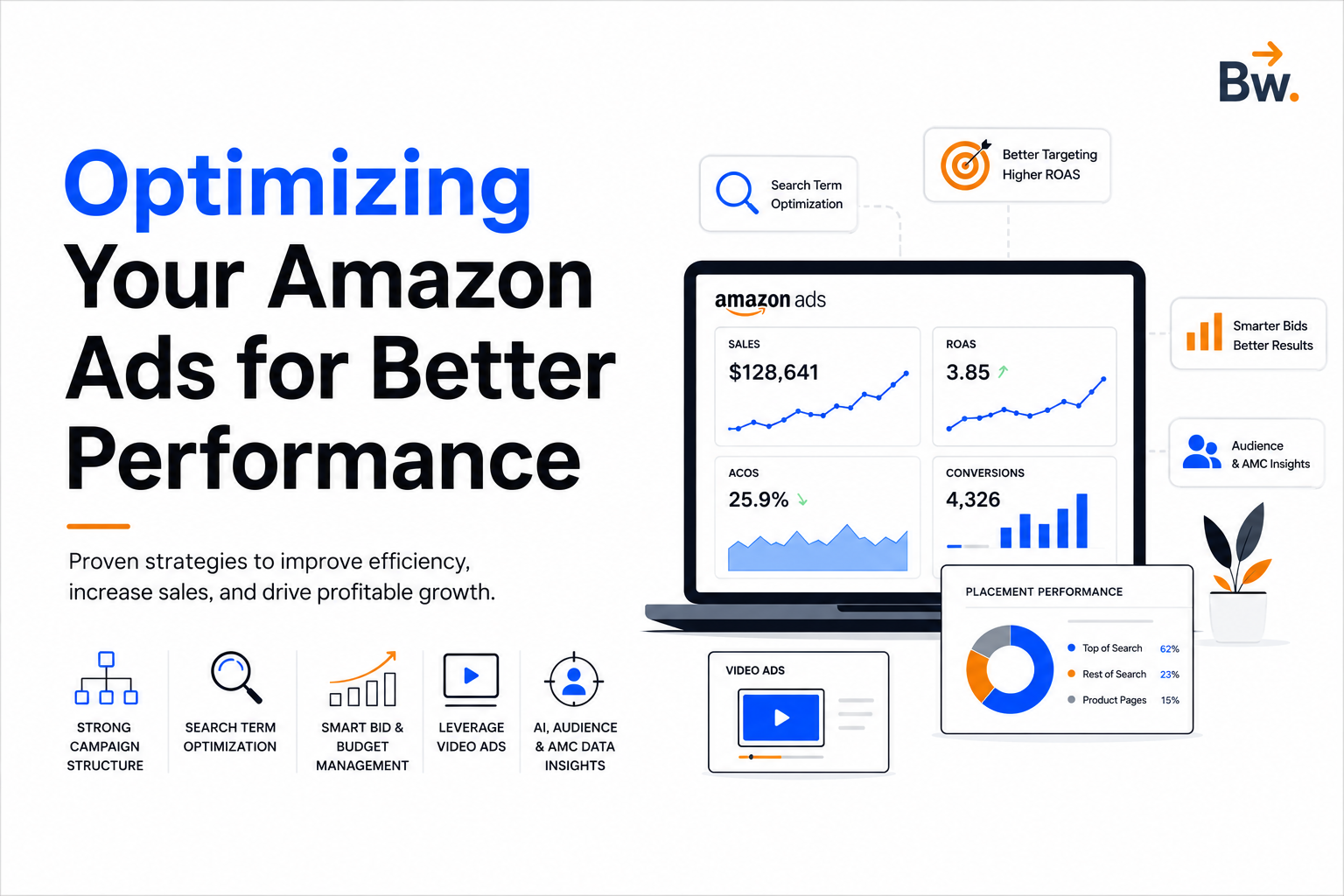
Amazon Ads optimization has changed significantly over the last few years.
There was a time when success largely came down to finding the right keywords, setting competitive bids, and monitoring ACoS. While those fundamentals still matter, Amazon's advertising ecosystem has become far more sophisticated.
Today, better performance isn't just about bidding on keywords. It's about understanding shopper intent, creating campaigns that work together, optimizing listings for AI-powered discovery, and making smarter decisions using data.
After nearly 10 years of managing Amazon Ads campaigns, I've found that the brands achieving consistent growth are the ones that view optimization as an ongoing process rather than a one-time task.
Here are some of the most important areas to focus on.
Build a Strong Campaign Structure First
Optimization becomes much easier when campaigns are organized properly from the beginning.
One of the most common issues I see in Amazon accounts is poor campaign structure.
Keywords with different objectives are mixed together. Research campaigns and scaling campaigns sit in the same place. Brand terms compete with non-brand terms. Different match types are bundled into a single campaign.
When this happens, performance data becomes harder to interpret and optimization decisions become less effective.
A well-structured account allows you to:
- Identify winning keywords faster
- Allocate budgets more effectively
- Control bids with greater precision
- Scale successful campaigns confidently
Think of campaign structure as the foundation of optimization. Without it, even good optimization decisions become difficult to execute.
Continuously Mine Search Term Data
Amazon Ads provides an enormous amount of data. The challenge is knowing where to look.
One of the most valuable reports available is the Search Term Report. This report reveals how shoppers are actually finding your products.
Over time, successful search terms should be promoted into dedicated campaigns where they can receive focused budgets and bidding strategies.
Likewise, poor-performing search terms can be reduced, excluded, or monitored more carefully.
Many advertisers spend most of their time reviewing campaign-level metrics. The real opportunities are often hidden deeper within the search term data.
Improve Conversion Rates Before Increasing Spend
A common reaction to slowing sales is increasing budgets.
In reality, improving conversion rates often delivers a far greater impact.
Every additional percentage point of conversion allows you to generate more sales from the same traffic.
Before increasing advertising spend, review:
- Main images
- Product titles
- A+ Content
- Product videos
- Pricing
- Reviews
- Product detail page content
Advertising can drive visitors to your listing. Only your listing can convince them to buy.
The highest-performing accounts typically combine strong advertising with strong conversion optimization.
Optimize Bids and Budgets Based on Performance
Not every keyword deserves the same investment.
The best-performing accounts consistently move budget toward proven opportunities.
Winning keywords should receive enough budget and visibility to maximize their potential. Keywords that show promise should continue to be tested and refined. Underperforming targets should be reviewed carefully rather than consuming budget indefinitely.
Similarly, budget allocation deserves regular attention.
Many advertisers unknowingly restrict their best campaigns with budget limitations while less efficient campaigns continue spending freely.
Optimization is often less about spending more and more about spending smarter.
Use Placement Data to Unlock Additional Performance
Amazon gives advertisers the ability to understand performance across placements such as:
- Top of Search
- Product Pages
- Rest of Search
These placements often behave very differently.
For many brands, Top of Search generates stronger conversion rates and higher sales volume than other placements.
By analyzing placement performance and adjusting bid modifiers accordingly, advertisers can often improve results without increasing overall spend.
Small placement adjustments can sometimes create meaningful improvements in efficiency and visibility.
Leverage Video Ads to Capture More Attention
As competition increases, simply appearing in search results is no longer enough. You also need to stand out.
Sponsored Brand Video campaigns have become one of the most effective ways to do this.
Unlike traditional ads, video ads allow you to:
- Demonstrate product benefits quickly
- Capture attention while shoppers scroll
- Communicate value before a click occurs
- Differentiate your product from competitors
In many categories, video ads still face less competition than traditional Sponsored Products placements.
For brands with strong creative assets, they often represent one of the most underutilized opportunities within Amazon Ads.
Optimize for Amazon's AI-Powered Future: COSMO and Rufus
Perhaps the biggest shift happening on Amazon today is the move from keyword matching to intent matching.
For years, Amazon's search engine primarily relied on matching search terms to listing content. That world is changing.
Amazon's AI model, COSMO, is designed to understand why a shopper is searching, not just what they are typing.
Two shoppers can enter the exact same search term and receive different results based on factors such as:
- Browsing history
- Purchase behavior
- Shopping patterns
- Engagement signals
Amazon is increasingly focused on identifying which products a specific shopper is most likely to purchase.
This has major implications for optimization.
Keyword stuffing becomes less effective. Natural, customer-focused content becomes more important. Listings that clearly communicate benefits, use cases, and customer needs are likely to perform better as Amazon's AI becomes more sophisticated.
At the same time, Amazon's AI shopping assistant, Rufus, is changing how shoppers discover products.
Instead of simply searching for "protein powder," shoppers can ask detailed questions and receive personalized recommendations.
Rufus evaluates information from:
- Product titles
- Bullet points
- Product descriptions
- Reviews
- Images
- Q&A content
Your product detail page is no longer just a sales page. It is becoming a data source that Amazon's AI uses to determine relevance.
The brands that win in the future will optimize not only for keywords but also for shopper questions, needs, and intent.
Use AMC to Understand What Is Actually Driving Sales
As Amazon becomes more personalized, traditional reporting tells only part of the story.
Many advertisers still evaluate campaigns individually.
The problem is that customers rarely purchase after interacting with a single ad.
A shopper might:
- See a Sponsored Brands ad
- Click a Sponsored Brand Video
- Return later through Sponsored Products
- Finally convert several days later
Standard reporting often attributes credit only to the final interaction.
Amazon Marketing Cloud (AMC) allows advertisers to understand the full customer journey.
With AMC, brands can analyze:
- Paths to purchase
- Ad type overlap
- New-to-brand customer behavior
- Cross-campaign influence
- Audience-level insights
This often leads to very different optimization decisions.
Campaigns that appear average in isolation may actually play a critical role in driving conversions later in the journey.
As Amazon moves toward increasingly personalized shopping experiences, understanding audiences will become just as important as understanding keywords.
Think Beyond Individual Campaign Metrics
The most successful Amazon advertisers in 2026 will not simply be the ones with the lowest ACoS.
They will be the brands that understand how all parts of the system work together.
Campaign structure. Search term optimization. Conversion rates. Video advertising. AI-driven discovery. Audience insights. Customer journeys.
Amazon is moving beyond a keyword-first platform and becoming an audience-first platform.
The advertisers that adapt to this shift early will have a significant advantage.
Final Thoughts
Optimizing Amazon Ads today requires a broader perspective than ever before.
The fundamentals still matter. Strong campaign structure, intelligent bidding, and conversion optimization remain essential.
But the future belongs to brands that understand how Amazon's AI systems, audience signals, and customer journeys influence visibility and conversions.
Most sellers are still optimizing for the Amazon of yesterday.
The opportunity lies in preparing for the Amazon of tomorrow.