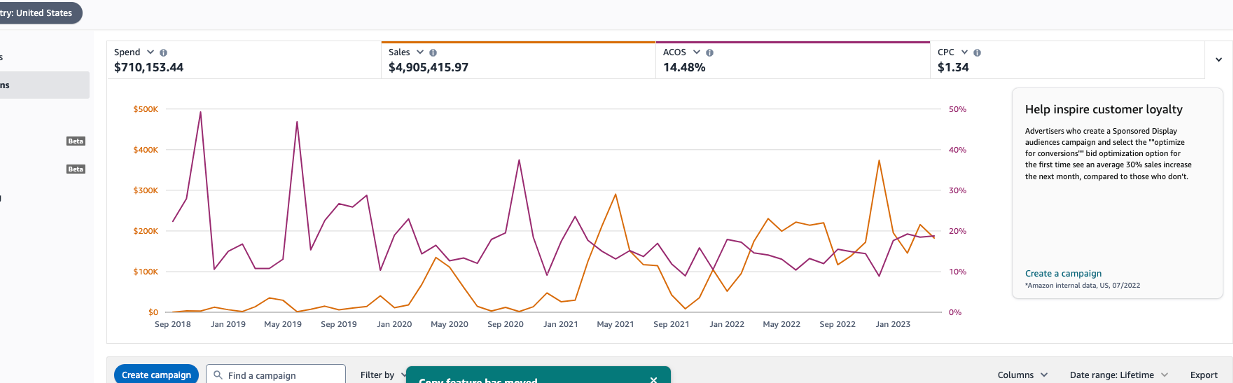
This case study shows how proper campaign restructuring and product-level focus can drive steady growth even when facing inventory challenges.
When we took over this account in August 2022, we found a broken campaign structure leaking ad spend, disconnected strategies wasting budget, and missed opportunities preventing growth. Over the next few months, we systematically rebuilt the foundation while managing through stock challenges.
The Outcome
Year-Over-Year Growth (Jan-Mar 2023 vs 2022)

January 2023:
- ✅ Overall sales: $394K (vs $94K in 2022) - 316% increase YoY
- ✅ PPC sales: $195K (vs $51K in 2022) - 278% increase YoY
- ✅ This was the 3rd highest sales month in the past 8 months
February 2023:
- ✅ Overall sales: $308K (vs $168K in 2022) - 83% increase YoY
- ✅ PPC sales: $145K (vs $95K in 2022) - 52% increase YoY
- ✅ YoY growth despite major products being out of stock
March 2023:
- ✅ Overall sales: $454K (vs $359K in 2022) - 27% increase YoY
- ✅ PPC sales: $215K (vs $174K in 2022) - 23% increase YoY
- ✅ Second highest sales month in the past 8 months
- ✅ Generated the highest page views compared to all previous months
What Changed?
We started by analyzing the existing setup and quickly identified the core problem: the campaign structure was preventing any meaningful optimization. Campaigns had 400+ keywords mixing broad, phrase, and exact match types, combined with both product and keyword targeting - all in single campaigns. This meant individual keywords got minimal exposure, performance data was too aggregated to be useful, and budget was being wasted on underperformers.
We needed to rebuild the structure completely, but we had to do it gradually to avoid losing momentum.
Overall:
- Added 61 new restructured campaigns focused on high-performing products
- Paused over 1,500 non-performing keywords that were wasting budget
- Dramatically improved ad impression quality and page view traffic
- Built a scalable foundation for continued growth
The Campaign Structure Problem
The existing setup was fundamentally broken:
- Most campaigns had 400+ keywords mixed together - making it impossible to give individual keywords proper exposure
- Match types were combined (broad, phrase, exact all in one campaign) - faster-spending broad terms ate the budget before exact match could perform
- Product targeting and keyword targeting were mixed in the same campaigns - different strategies competing for the same budget
- Performance data was too aggregated to identify what was working and what wasn't
This wasn't a small fix - it required a complete rebuild.
Gradual Restructuring Approach
We couldn't rebuild everything overnight without risking sales, so we took a strategic, phased approach:
- Conducted thorough analysis to start with the highest-potential product
- Created 14 new focused campaigns for this single product, segmented by match type, target relevance, and keyword density (under 20 targets per campaign)
- Watched the results carefully to validate the approach before expanding
- The results proved the strategy worked - this product hit its highest sales in the last 4 months by March
This gradual rollout let us prove impact while maintaining momentum.
Expanding the Rebuild Across Products
After proving the approach, we expanded to other high-priority products:
- Applied the same restructuring strategy to additional key products across the catalog
- Built separate campaigns for each product, segmented by targeting relevance (generic to highly relevant), match type, and target density
- This gave us precise control over bids and budgets at the product level
- By March, we'd added 61 new campaigns across the focused product range
Each product now had a proper structure that could scale efficiently.
Cutting Wasted Spend Aggressively
With better structure in place, we could clearly see what wasn't working:
- Identified and paused over 1,500 keywords that had generated zero sales - pure wasted spend
- Added negative keywords aggressively to prevent irrelevant searches from eating budget
- Removed duplicate and redundant keywords that were competing with themselves
- Reallocated all that saved budget to proven performers
Every dollar now went to keywords and products that actually converted.
Managing Through Stock Challenges
Stock issues hit hard in February and persisted through March:
- Key products went out of stock across multiple categories
- We created a stock-level analysis to track inventory and adjust budgets accordingly
- Prevented overspending on low-stock products that had strong organic sales (no point paying for traffic that would sell out anyway)
- Shifted ad spend to in-stock products to maintain overall account growth
- Products were restocked mid-March, allowing us to scale back up
Our product-level approach let us manage this efficiently without losing overall momentum.
Leveraging Placement Adjustments
The new campaign structure unlocked better control over placements:
- With focused campaigns and fewer targets per campaign, we could use placement adjustments effectively
- Increased bids on high-converting placements (top of search, product pages) for winning products
- This wasn't possible with the old structure where everything was mixed together
Better structure meant better control, which meant better performance.
Product-Level Budget Allocation
We set TACOS targets for each product based on margins and monitored closely:
- Established monthly budget limits based on estimated sales to prevent overspending
- Reviewed and adjusted budgets weekly to stay on target
- Some products ran higher TACOS than planned in March as we scaled aggressively - we implemented stricter monthly limits to keep efficiency in check
This product-first approach ensured we scaled profitably.
The transformation took time because we did it right. By March, the account had hit its second-highest sales month in the past 8 months at $454K, despite ongoing stock challenges. Products that got restructured first showed the biggest gains. The foundation is now in place to scale aggressively as stock stabilizes.
Key Takeaway: Consistent YoY sales growth is possible with a product-led approach, strong campaign foundation, and strategic adaptability to navigate challenges without losing momentum.