Proven strategies to maximize your Amazon listing conversion and Ad performance

Your product title is the single most valuable piece of real estate on your Amazon listing. It is the first thing the Amazon algorithm reads to determine your organic ranking, and it is also the first thing, apart from the image, a shopper reads when deciding whether to click on your product or scroll past.
A poorly optimized title bleeds Ad spend and suppresses organic rank. A well optimized title, on the other hand, drives higher Click-Through Rates (CTR), improves Conversion (CVR), and lowers your Advertising Costs (ACoS).
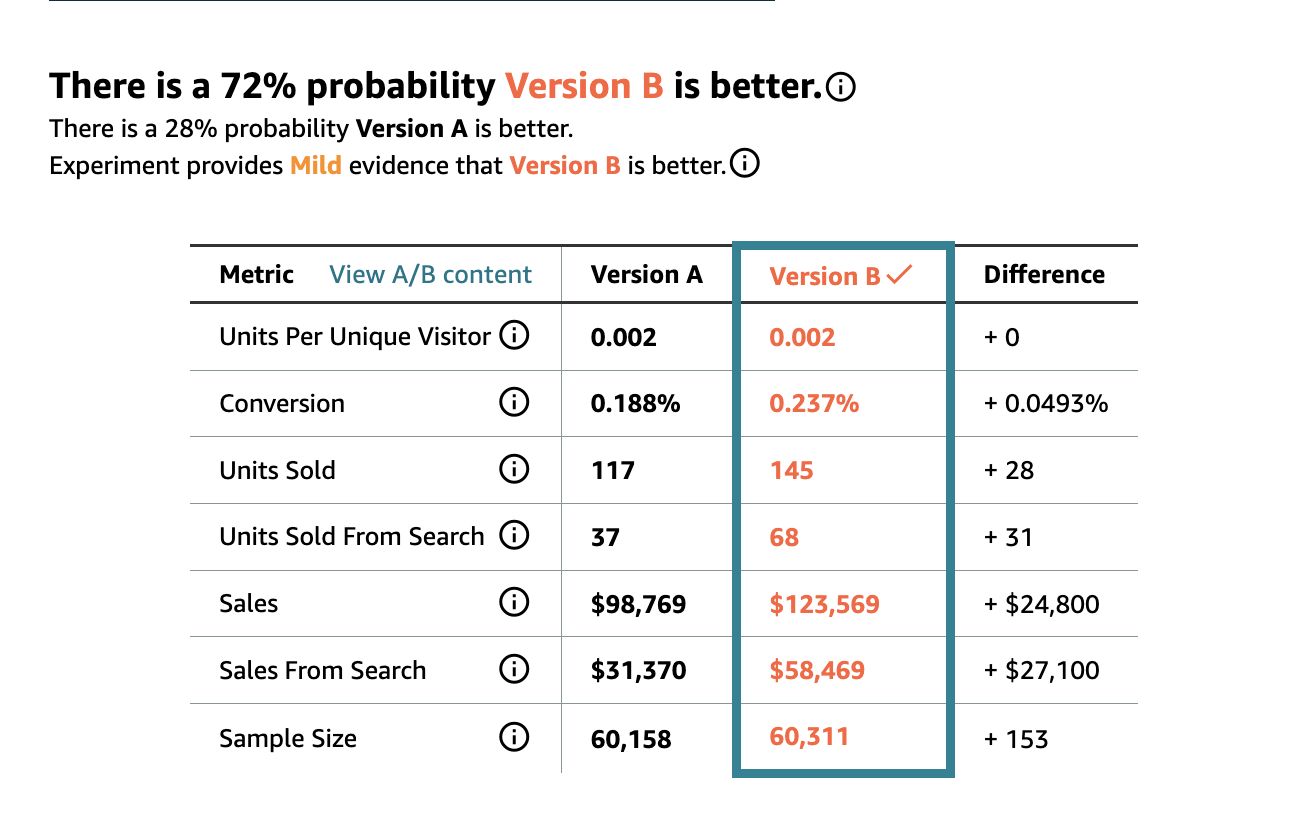
We have run various A/B tests on the titles in the past. Here are 2 case studies showing some of our biggest wins, in terms of conversion, sales and order uplift, and the winning % of over 72%.

✅ Search Revenue: Increased by $27,100 (from $31k to $58k).
✅ Conversion Rate: Improved from 0.19% to 0.24%.
✅ Units Sold from Search: Nearly doubled (from 37 units -> 68 units).
While a 0.05% absolute increase looks small on paper, it represents a 26% relative lift in efficiency. That is 26% more revenue for every dollar of traffic we drive.

Winning Probability: 87% probability that Version B is better, providing Considerable evidence for the change.
Conversion Rate: Increased from 0.129% to 0.158% (+0.0286%).
Sales Lift: Version B generated $3,779 vs. Version A's $2,867 (a +$912 increase during the test window).
Units Sold: Jumped from 55 to 71 (+16 units).
The good news? It's not complicated.
This 6-step framework helps to develop optimized titles, then test them with real data through A/B testing. Amazon provides a Free built-in tool - Manage Experiments (available in Seller Central under Brands > Manage Experiments).
Start with a thorough Keyword research for the product. If you’re running Ads, you can also analyse your search term report, as well as competitors data for a list.
Then, look at high-traffic keywords that are highly relevant to the product.
When your title aligns with what shoppers are searching for, two things happen:
✔️ your search ranking improves with the title match, and
✔️ shoppers immediately recognize your product as relevant to what they typed.
This drives both discoverability and trust.
Place your most critical keywords in the first 80 characters.
This optimizes your product title for mobile as the title gets truncated.
Optimizing for mobile is crucial. We’ve found that on avg. over 50% of the traffic on Amazon comes from Mobile. Also, a lot of shoppers shop via Amazon shopping app.
When making a buying decision, Shoppers scan your product title. Showing key benefits and features helps communicate the value they will get, which helps them make a buying decision.
So, don't just describe what your product is—communicate why it matters.
Is it waterproof? BPA-free? Portable? Compatible with specific models? Includes a warranty? These details belong in your title.
A cluttered title is not easy to read and may even look spammy. A clean text with separators like pipes (|) or dashes (-) creates visual breaks between key information. Making it easy for shoppers to scan and process quickly.
Poor example: Water Bottle Insulated Stainless Steel BPA Free Leak Proof Portable32oz
Better example: Insulated Water Bottle | Stainless Steel | BPA-Free & Leak-Proof | Portable | 32oz
Pro Tip: Avoid keyword stuffing. Don't repeat "Water Bottle" three times. Use synonyms if possible (you may find those in keyword research as well; use the ones with good search volume). This reads better and keeps you safe from Amazon’s suppression algorithms.
As you are creating new titles, create 2-3 variations. This gives you 2-3 titles to test, one after the other. This helps in regular testing of the titles, which is key.
A common mistake is to run a test for a few days and make a decision based on that data, which is incomplete.
Here's the problem with short tests: you're capturing noise, not signal. Weekend versus weekday traffic patterns, promotional periods, seasonal fluctuations—all of these create variability that can skew results.
A proper test requires 3-4 weeks minimum to account for these variables and establish consistent performance trends.
If you're in a high-volume category, you may accumulate sufficient data in 2 weeks. But even then, extending the test helps validate that your results are sustainable, not just a temporary spike.
Found a winning title? Excellent. Don’t stop there. It’s time to test another variation.
Let's say your first title optimization improves conversion by 0.5%. That's a modest gain, but it's measurable progress.
Then you test again and achieve another 0.5% improvement.
That's not simply 1.0% total improvement—it's 0.5% on top of your already-improved baseline, which equals approximately 1.0025% cumulative gain. Run several tests throughout the year, and these incremental improvements compound into substantial revenue growth.
Small, consistent improvements add up to significant competitive advantage over time.
Don’t ignore your titles. Optimise them to maximize your product conversion.
Higher conversion -> More sales -> higher returns on Ad spend -> Unlocked growth potential.
We, at Broadway Ad consult, understand that Conversion and Ad performance are strongly connected. A lift in conversion leads to better return on every dollar spend. Therefore, we include listing optimisation, essentially, image, title, A+, storefront and description as part of the strategy and we go beyond just managing ads to provide useful ways to improve.